


England has both private and state schools. All are accredited by the Ministry of Education and undergo regular inspections. The country has a single National Curriculum, compulsory for all, though each school is allowed to add other subjects at its own discretion.
- primary school. Students study up to 12 subjects, with the number increasing depending on age.
11-16 years
- secondary school. Up to age 14, students study a large number of compulsory subjects. From age 14, the two-year GCSE programme begins, where the student chooses 5-10 subjects and spends two years preparing to sit centralised exams in the chosen subjects.
Earning a GCSE (General Certificate of Secondary Education) is an important milestone in a student's education, since it marks the end of compulsory education, after which the student can choose their future path. They can continue at school for the higher-level A-level programme, enrol at a vocational college, or start working.
16-18 years -
the pre-university A-level programme, at the end of which students sit centralised exams. This is a very important stage, since university admission is based on exam results. The A-level programme lasts two years: in the first year (AS), students study 4-5 subjects; in the second (A2) - 3-4 subjects. Each subject gets 6-8 hours a week. As a rule, the choice of subjects is tied to future university study.
In recent years, a growing number of English schools have started offering the International Baccalaureate (IB) programme as an alternative to A-level. This programme opens the door to many universities beyond the UK. Students choose one subject from each of 6 groups, studying 3 subjects at standard level (3 hours a week) and 3 subjects at higher level (5 hours a week).
The private school is the foundation of classic British education. Every English family's dream is to give their child a private education. It might seem odd - why, when there are so many free state schools, and scenes from the works of Somerset Maugham, Charles Dickens and other English authors come to mind, in which private schools appear as some kind of monster, where children are beaten with sticks and doused with cold water?
The English private school has stood not just the test of time, but the test of centuries. Today it's a modern institution where every child is treated as a free, independent individual. Here, they know how to not only give students the knowledge they need, but also unlock each student's talent and help them make sense of the world around them. Modern equipment, science labs, computer facilities, and sports grounds are all impressive. Teachers are highly qualified, many of them Oxford and Cambridge graduates. Small classes, regular testing, and homework done under teacher supervision - all this means that 90% of private school graduates go on to university. These schools are known for a well-organised teaching process and excellent academic results, a high standard of discipline, and a positive influence on a child's personal development.
The UK today has more than two thousand private schools. How do you choose the right one for your child?
There are day schools and boarding schools, schools for boys only or girls only, as well as co-educational schools; purely English schools and international schools. What age is best to go, and which programme?
Baltic Council for International Education has many years of experience working with private schools. We've visited many of them in person, know the staff and teachers, and would be happy to share our knowledge with you and help find the best option for you and your child.
Boarding schools
These schools are usually in the countryside or on the outskirts of a town, since they need large grounds for teaching buildings, dormitories, a pool, football pitches, tennis courts, and so on.
Besides the compulsory subjects set by the national curriculum, students are offered a whole range of elective subjects here. After lessons - clubs and societies. Almost every school has a drama studio, a choir, and dance and sports clubs. Most such schools have centuries of history and have remained true to their traditions. A growing number of boarding schools have moved to co-education (boys and girls together), but the world-famous Eton, Harrow, Dulwich, Badminton, Roedean and many others remain single-sex schools. Their high rankings confirm the wisdom of staying the course they've chosen.
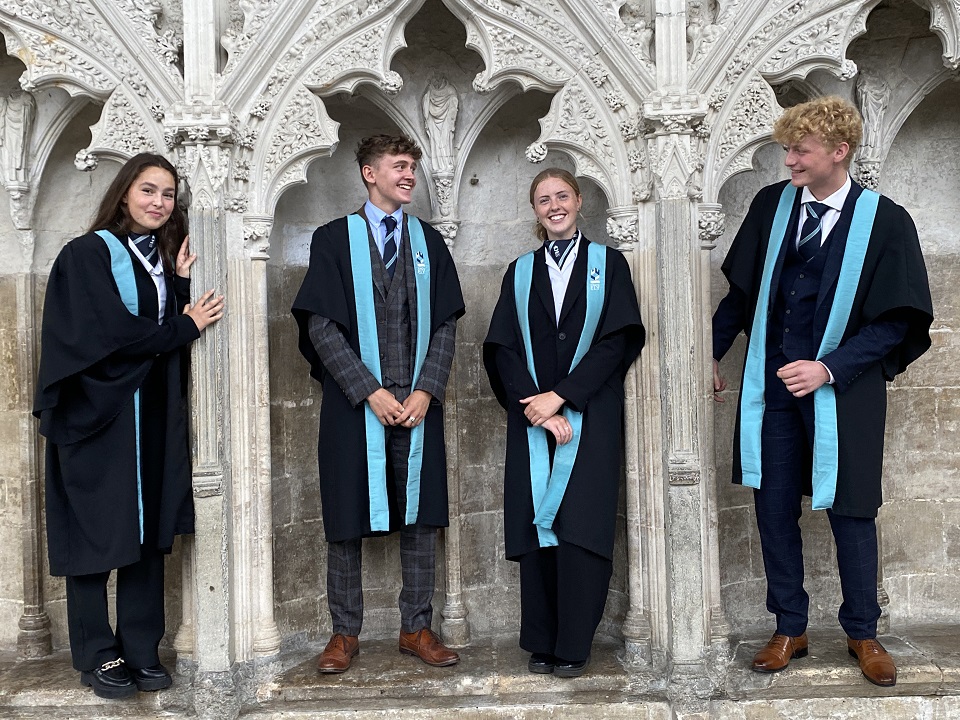
Students at such schools wear uniform and follow a strict daily routine.
Admission to a boarding school is based on testing. You'll also need to provide a school report from the last year (some require three years). Each school has its own test. Some schools require an in-person visit and interview. You need to apply to "top" schools well in advance, at least a year before studies begin.
Most schools entrust our company to conduct testing at our offices, which is very convenient for both the prospective student and their parents.
Under UK law, all international students at a boarding school must have a guardian in the country. This can be a family friend, at least 25 years old and permanently resident in the UK. Our company also works with a number of accredited agencies providing guardian services.
In the middle of the last century, when there was major progress in science and technology, even the seemingly unshakeable classic English school underwent change. There was growing talk of raising a free, independent individual. Uniform school dress, compulsory chapel attendance, and strict discipline came under increasing criticism. This is when alternative private schools for senior students appeared, so-called "Tutors Colleges", also known as "Independent VI-th Form Colleges". These schools typically accept students from age 15 and offer GCSE, A-level or International Baccalaureate programmes. There's no compulsory chapel attendance or choir. The main goal is serious study and university admission. Teachers pay very close attention to each student's progress and, if needed, are ready to provide individual lessons. Today, many of these colleges lead the rankings and sometimes far exceed the "old" schools in the number of students admitted to top universities.
To apply to such colleges, you need to provide a report from the last year of study and sit subject tests. Some colleges (for example, Cambridge Tutors College) strongly recommend a personal interview.